
Blue Blocks Montessori School: 70 Child-led Biomimicry Research Papers Published, Youngest Researcher Six
Children aged six to sixteen at Blue Blocks Montessori School, Tellapur, presented 70 biomimicry research papers this morning, produced over four months with a parent as co-researcher. Each paper is published openly on Zenodo under the child’s own ORCID iD. The exhibits opened to visitors at 9:00 AM; the papers were unveiled at 11:30 AM.
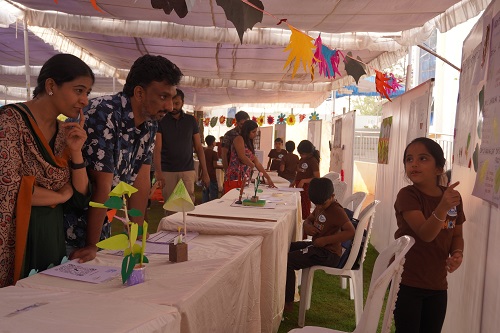 |
A young researcher explains her plant study to visitors at the Biomimicry Park, Explore Montessori 2026, Blue Blocks Montessori School, Hyderabad, 28 November
Biomimicry, learning from how nature solves a problem, is taught almost exclusively at university and in industrial research. Here, each child spent 10 to 14 days observing one element of local nature, recorded it in a structured dataset, worked out what the organism was doing and why, and proposed what that principle could teach us.
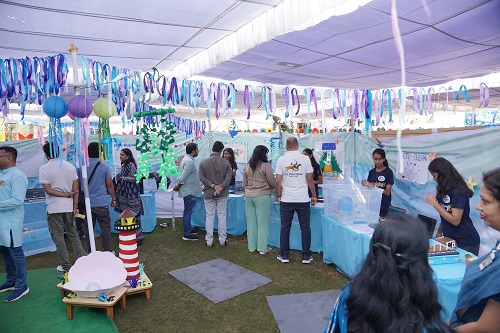 |
The Biomimicry Park at Blue Blocks Montessori School, Hyderabad: families present 70 child-led research papers across five arms of discovery, Explore Montessori 2026
“We asked each child to look at one thing from nature, every day for two weeks before building anything,” said Pavan Goyal, Founder and Principal Investigator of Blue Blocks. “Most adults never do that. That is where every piece of biomimicry starts.”
Four of the studies (children’s names withheld for safeguarding)
The balcony dawn chorus (ages 6 to 12). Fourteen mornings logging which bird called, when, and in what order. Concept: an acoustic monitor that separates bird song from human noise.
Does a plant smell make you calmer (ages 6 to 12). A fragrance from eight plant parts, tested on adult volunteers in a randomised crossover against a control, measuring self-rated calm and a brain-oxygenation reading.
Pathways of the garden (ages 6 to 12). Fourteen days tracking where insects and small animals walk in a community park, and why. Concept: pedestrian routes drawn from the ones nature already uses.
A manta ray that cleans water (ages 12 to 16). How the ray glides and filters water across a wide mouth, modelled as a surface drone with a proposed silica system to capture heavy metals.
Every parent attended a design-thinking workshop before they began the research. “They knew exactly where to step back,” said Sandhya Rao, Director of Operations and Biomimicry Pedagogy Lead. “The parent is the safety adult and guide; the child is the lead researcher.” The model is documented in a published case study by the school’s research arm, Blue Blocks Micro Research Institute. An earlier pre-registered study of 81 children asked only to “draw a place where life can exist” found more than three-quarters drew natural worlds, strongest in the youngest.
“We are not claiming these young researchers have solved industrial engineering overnight,” said Dr Sreemoyee Chakraborty, Dean of Research, Blue Blocks Micro Research Institute. “We are demonstrating a replicable, ethical method where a child’s own field observation is mentored, documented and published as an open-access research preprint.“
Event. Explore Montessori 2026, the school’s annual exhibition, themed this year as the Biomimicry Park. Saturday, 28 November 2026, Blue Blocks Montessori School.
Spokespeople. Pavan Goyal, Founder and Principal Investigator · Munira Hussain, Co-founder and Director of Pedagogy · Sandhya Rao, Director of Operations and Biomimicry Pedagogy Lead · Dr. Sreemoyee Chakraborty, Dean of Research, Blue Blocks Micro Research Institute · Dr. Raunak Sharma, Science Communications & Research Associate, Blue Blocks Micro Research Institute.
About Blue Blocks Micro Research Institute. The research arm of Blue Blocks Montessori School. The school, founded in Hyderabad in 2009 for children from 1.5 to sixteen years, has taught biomimicry since 2020 and opened its Biomimicry Hive, designed with IIT Hyderabad, in 2022. The institute publishes practitioner-led, open-access research on child development and education with persistent identifiers, mentors the children’s and families’ own studies, and this month published the school’s K-10 biomimicry method as an open canon.
Note to editors. The papers are preprints: original work archived openly on Zenodo before journal peer review, reviewed by Blue Blocks Micro Research Institute mentors and published with a DOI. Exhibits were papers and datasets; some included 2D or 3D concept models; none were working prototypes.


